
Y. N. Zhan, D. D. Huang, H. L. Wang, Y. Q. Gao, Y. J. Li, S. H. Zhu, Q. Y. Liu, J. Duan, L. Yang, W. Xu, H. B. Zhong, L. Y. Zhou, Y. J. Li, C. Huang, Q. Y. Fu, T. Hoffmann, and R. J. Huang* (2025), Formation Kinetics and Yields of Secondary Organic Aerosol from Benzothiazoles Based on Oxidation Flow Reactor and Ambient Studies, Environmental Science & Technology Letters, 12(10), 1366-1372, doi:10.1021/acs.estlett.5c00714.
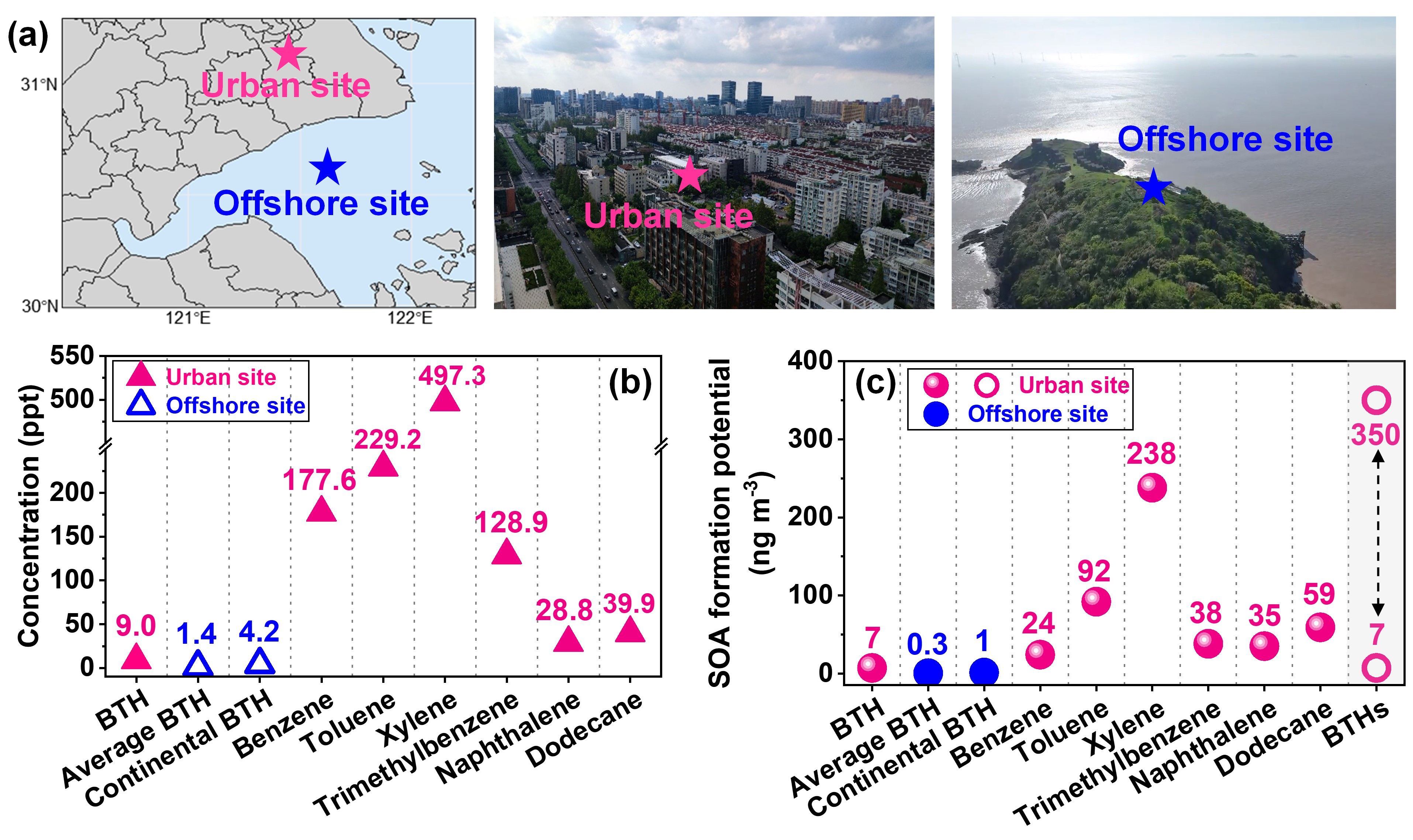
Benzothiazoles (BTHs) are an important class of emerging organic pollutants from volatile chemical product emissions, which have been detected in atmospheric environments due to their extensive use, especially as vulcanization accelerators in tire production. However, studies on the atmospheric photochemical oxidation of BTHs remain very limited, hindering the assessment of their atmospheric impacts. Herein, we systematically investigated the reaction kinetics and SOA yields of benzothiazole (BTH, the parent compound of BTHs) photo-oxidation under various experimental conditions using an oxidation flow reactor. The rate constant for BTH reacting with OH radicals, (3.14 ± 0.20) × 10-12 cm3 molecule-1 s-1, was similar to that of single-ring aromatics like toluene, yet its SOA yield was comparable to that of bicyclic aromatics like naphthalene. Furthermore, we found while NOx suppressed the BTH SOA production, relative humidity enhanced its production. Further field measurements revealed significant SOA formation potential from BTH photo-oxidation in typical urban areas, comparable to well-known benzene or naphthalene. Gaseous BTH in offshore atmosphere was also been detected, indicating its potential impacts on marine environments. Our results elucidate the atmospheric photochemical processes of BTH, revealing its important but previously overlooked contribution to ambient SOA formation.