
W. Yuan, R. J. Huang*, J. C. Shen, K. Wang, L. Yang, T. Wang, Y. Q. Gong, W. J. Cao, J. Guo, H. Y. Ni, J. Duan, and T. Hoffmann (2023), More water-soluble brown carbon after the residential "coal-to-gas" conversion measure in urban Beijing, npj Climate and Atmospheric Science, 6(1), doi:10.1038/s41612-023-00355-w.
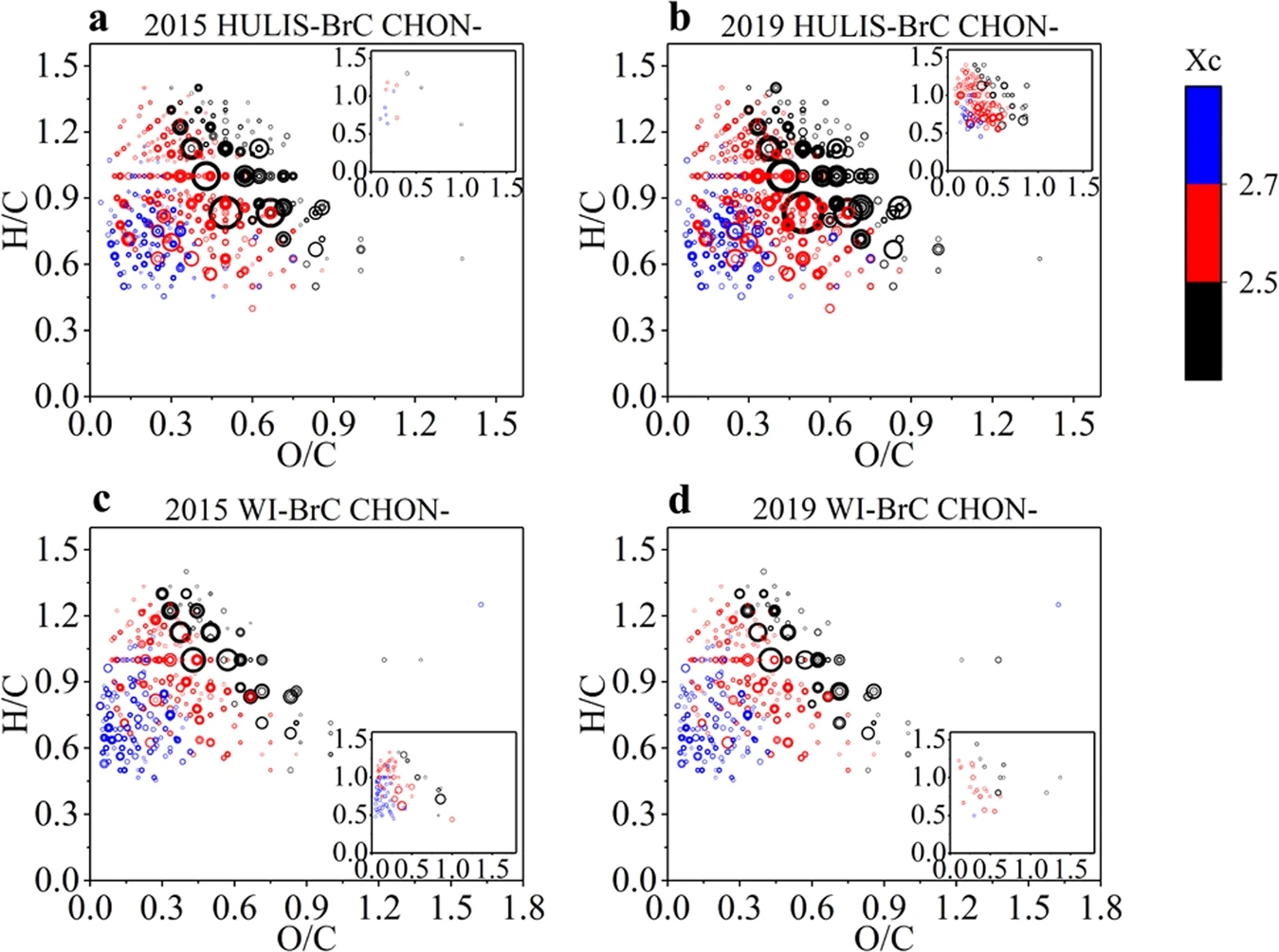
The implementation of air pollution reduction measures has significantly reduced the concentration of atmospheric fine particles (PM2.5) in Beijing, among which the "coal-to-gas" conversion measures may play a crucial role. However, the effect of this conversion measure on brown carbon (BrC) is not well known. Here, the chemical composition of BrC in humic-like fraction (HULIS-BrC) and water-insoluble fraction (WI-BrC) were characterized for ambient PM2.5 samples collected in Beijing before and after the "coal-to-gas" conversion measure. After the conversion measure, the number of HULIS-BrC compounds increased by ~14%, while the number of WI-BrC compounds decreased by ~8%. The intensity of over 90% of HULIS-BrC compounds also increased after the conversion measure, and correspondingly the O/C ratios of CHO and CHON compounds in HULIS-BrC fraction generally increased with the increase of intensity ratios after/before the conversion measure, indicating that there were more water-soluble highly oxygenated BrC compounds after "coal-to-gas" conversion measure. On the contrary, the intensity of more than 80% of WI-BrC compounds decreased after the conversion measure, and the O/C ratios of CHO and CHON compounds in WI-BrC fraction generally decreased with the decrease of intensity ratios after/before the conversion measure, indicating that after the "coal-to-gas" conversion measure the water-insoluble low oxygenated BrC compounds decreased. This work sheds light on the differences in the chemical composition of BrC between before and after the "coal-to-gas" conversion measure and suggests that future studies on the residential coal combustion BrC and secondary BrC deserve further exploration.