
H. Y. Ni, H. B. Zhong, Y. Wang, P. Yao, J. Tian, Y. Y. Ma, R. J. Huang*, and U. Dusek (2025), Reduction in Organic Aerosol from Coal Combustion is Partially Offset by Enhanced Secondary Formation during the Beijing Coal Burning Ban, Environmental Science & Technology, 59(18), 9155-9166, doi:10.1021/acs.est.4c13051.
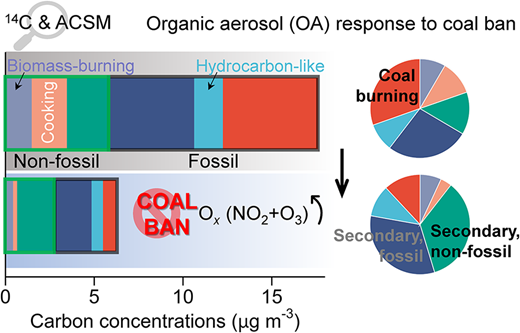
A coal ban policy in northern China during winter 2017 enforced a switch from coal to gas or electricity for residential heating, providing a unique opportunity to study the effect of reduced coal combustion emissions on organic aerosol (OA). This study explores OA composition, sources, and atmospheric transformations in Beijing before and during the coal ban using online aerosol chemical speciation monitor (ACSM) and offline 14C measurements. Four primary factors (hydrocarbon-like, cooking, biomass burning, coal combustion OA) and one secondary factor (oxygenated OA, OOA) were resolved from ACSM. In response to the coal ban, OA concentrations generally decreased, but coal combustion OA decreased most strongly, consistent with the decreased fossil carbon contributions to OA (67 ± 3% before vs 55 ± 4% during the ban). Concurrently, the OOA fraction increased from 45 to 72%, due to a larger decrease in concentrations of primary OA (POA; 59–88%) compared to OOA (34%), highlighting the enhanced secondary aerosol formation during the coal ban period. This aligns with the 14C evidence of higher water-soluble carbon in fossil OA (which has mostly secondary sources). During the coal ban period, Ox concentrations doubled and were positively correlated with the OOA fraction, highlighting strong photochemical OA production. The results show that the reduction of POA from stringent clean air actions is partially offset by enhanced secondary OA formation.