
Z. Zong, M. Xia, C. S. Lin, X. R. Chen, L. K. Xue, Q. Y. Li, Y. F. Jiang, C. G. Tian, X. H. Fan, Q. Yuan, X. F. Wang, Y. J. Zhu, J. S. Zhang, S. C. Lee, Y. J. Mu, J. Li, X. Fu, C. H. Ren, X. Huang, C. Yan, W. Nie, A. Badia, G. Zhang, A. J. Ding, R. J. Huang*, M. Kulmala, A. Saiz-Lopez, T. Wang, and W. X. Wang (2026), Isotopic constraints on the origin of reactive chlorine in the troposphere, Science Advances, 12(3), eaeb5397, doi:doi:10.1126/sciadv.aeb5397.
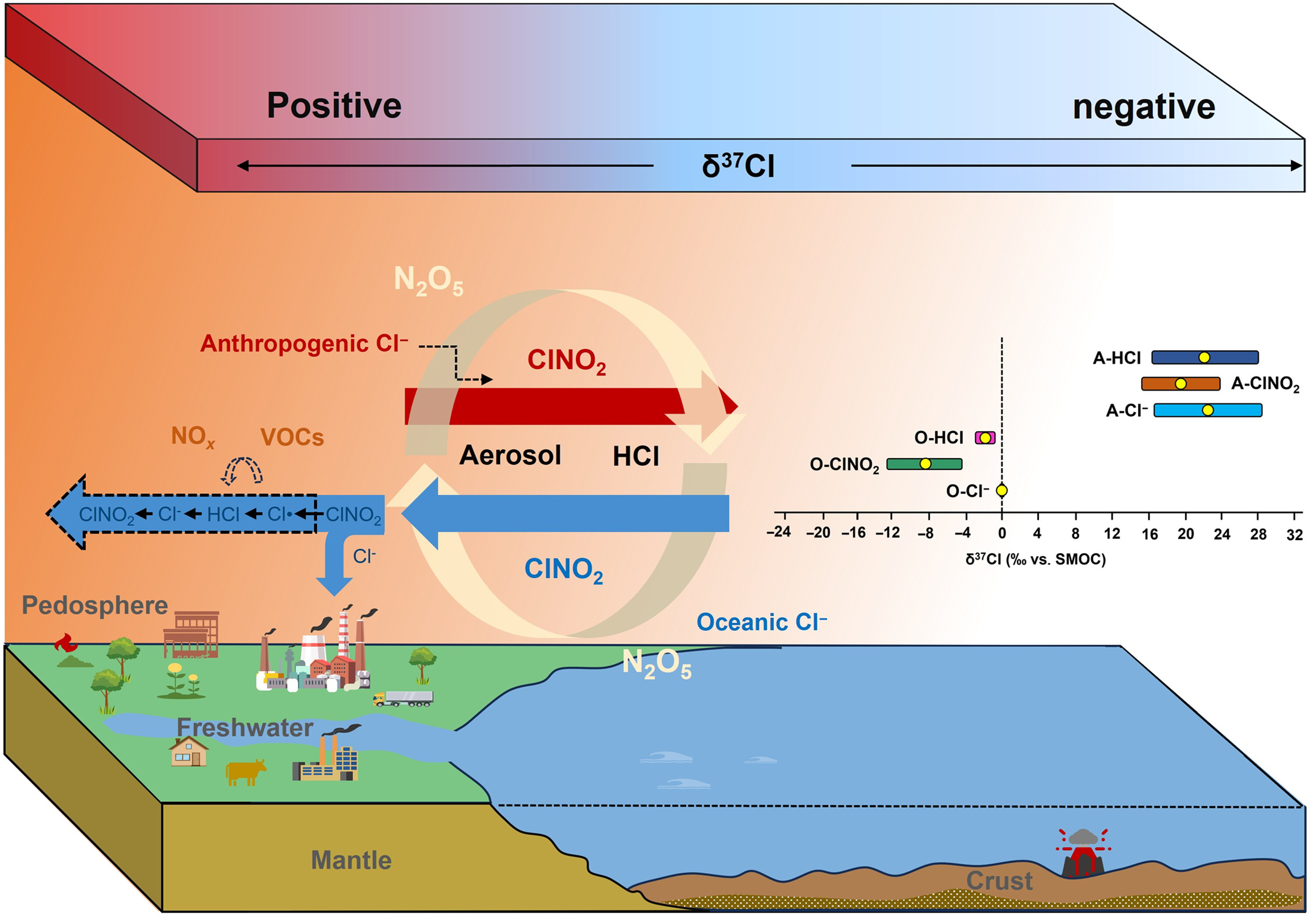
Oceanic and anthropogenic processes, such as sea-salt emissions and combustion activities, release substantial amount of reactive chlorine into the troposphere, affecting air quality, ozone depletion, and climate change. However, distinguishing between these sources for reactive chlorine remains challenging. Here, we establish isotopic constraints on the origin of tropospheric reactive chlorine using chemical ionization mass spectrometry to analyze nitryl chloride (ClNO2). Field observations from four regions in China reveal a much broader isotopic value (δ37Cl) range for ClNO2 (−21 to +39‰) than previously documented for Earth’s chlorine reservoirs. Notably, significant δ37Cl differences for ClNO2 from sea-salt emissions (−9 ± 4‰) and anthropogenic combustion sources (+20 ± 7‰) were identified. These distinct isotopic signatures, combined with field data, highlight the important role of oceanic chlorine in air pollution, with its chemical cycling affecting not only coastal regions but also extending into inland areas. This research advances our understanding of chlorine’s behavior and cycling in the troposphere.