
Y. N. Zhan, D. D. Huang, Y. Q. Gao, L. Y. Zhou, J. C. Shen, W. Yuan, J. Duan, X. Li, Z. F. Tang, H. B. Zhong, C. Huang, H. L. Wang, and R. J. Huang* (2026), Molecular Tracking the Formation and Aging of Secondary Organic Aerosol from Benzothiazole Photooxidation, Environmental Science & Technology, 60(15), 11597-11607, doi:10.1021/acs.est.5c17162.
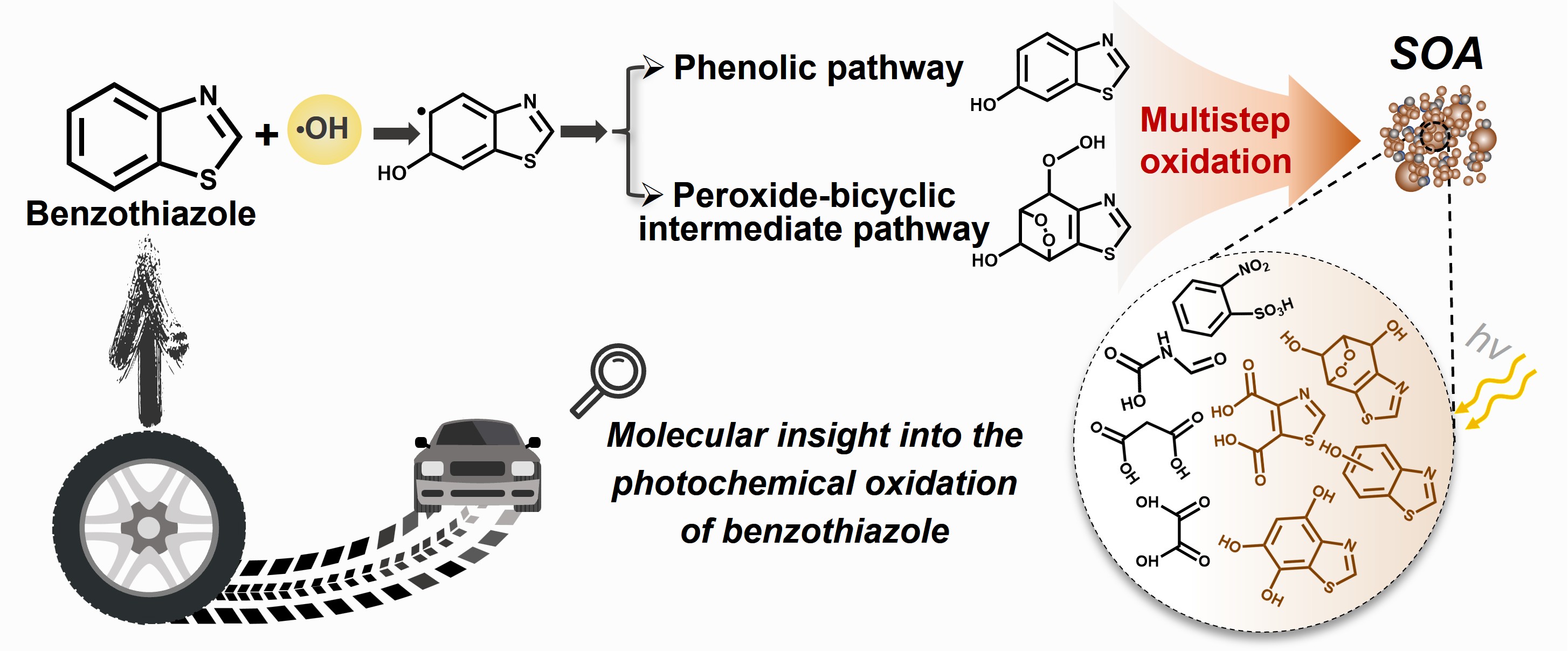
Benzothiazoles (BTHs) are emerging pollutants released mainly from tire wear. They can react with OH radicals to form secondary organic aerosol (SOA), but the underlying reaction pathways and molecular products remain unclear. Herein, the photooxidation of benzothiazole (BTH, the parent compound of BTHs) was investigated, and 137 gaseous and 129 particulate products were identified. Thiazole ring-retaining CHONS compounds were major products, indicating preferential OH attack on the benzene ring. The photooxidation was initiated by OH addition and proceeded via the phenolic pathway or the peroxide-bicyclic intermediate pathway to yield first-generation products (e.g., C7H5ONS and C7H7O5NS), which were further transformed into low-volatility CHONS compounds by multi-generation OH oxidation and autoxidation. Thiazole ring-retaining compounds acted as chromophores and contributed to light absorption of BTH-derived SOA, with a mass absorption efficiency at 365 nm of 0.37 m2 g-1 at OH exposure of 9 × 10¹¹ molecules cm-3 s, comparable to fresh SOA from benzene or ethylbenzene oxidation. However, enhanced aging fragmented thiazole ring-retaining compounds into low-molecular-weight CHO/CHON compounds (e.g., carbonyls and amides), reducing SOA mass and light absorption. Notably, nitrogen was retained in reduced organic forms, whereas sulfur was oxidized to inorganic sulfate. This study provides molecular-level insight into the benzothiazole photooxidation processes.